
They pop up regularly – media hypes about supposed astronomical events. There’s no avoiding them on social media, and from there, the virus often spreads to newspapers and TV networks.
Past and recurrent hypes
Almost every year, we are told that the ‘Comet of the Century’ is just around the corner and may even become visible in plain daylight, only to be almost invisible to the naked eye, if it doesn’t fizzle completely.
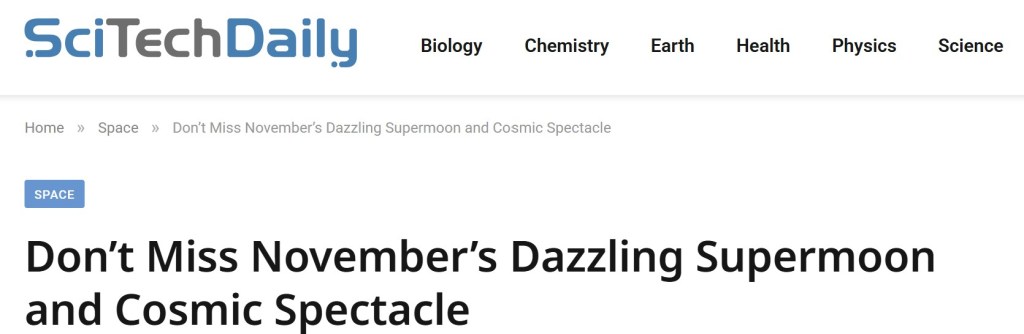
Another favorite is the ‘Super Moon’. This hype pops up every few months. The Moon indeed appears in different sizes for an Earth based observer. That’s caused by the Moon’s slightly elliptical orbit. Still, a ‘Super Moon’ appears only 7% bigger than an average and 14% bigger than the smallest possible Full Moon. Due to lack of a side-by-side comparison, the difference is all but invisible to the casual observer. The impression of a huge Moon rising is caused by an optical illusion in our brain and can be observed every month around Full Moon.
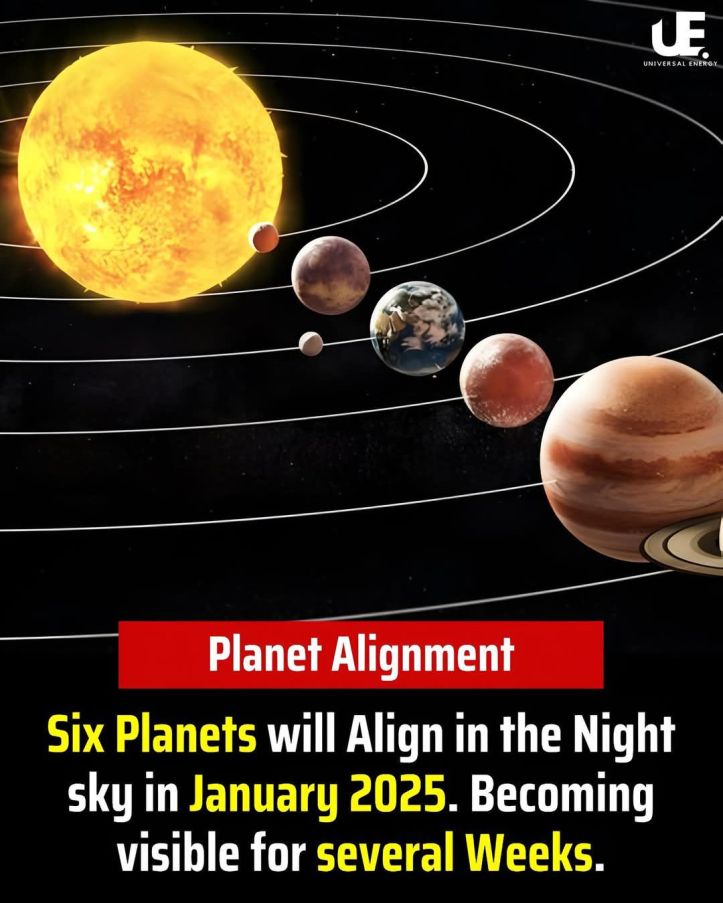
In early 2025, the ‘Planet Alignment’ was the next big thing. Only that the planets didn’t align at all. If anything, there was a planet parade in our sky, enabling us to see all naked eye planets during a single night and 6 planets at the same time, while only 4 of those are naked eye objects. As nice as this was, it wasn’t an extremely rare event and definitely no reason for end-of-the world scenarios.
The ‘Smile in the Sky‘
The latest addition to this collection of astronomy hypes is the ‘Smile in the Sky’ conjunction that is supposed to happen in the early morning of 25. April 2025:
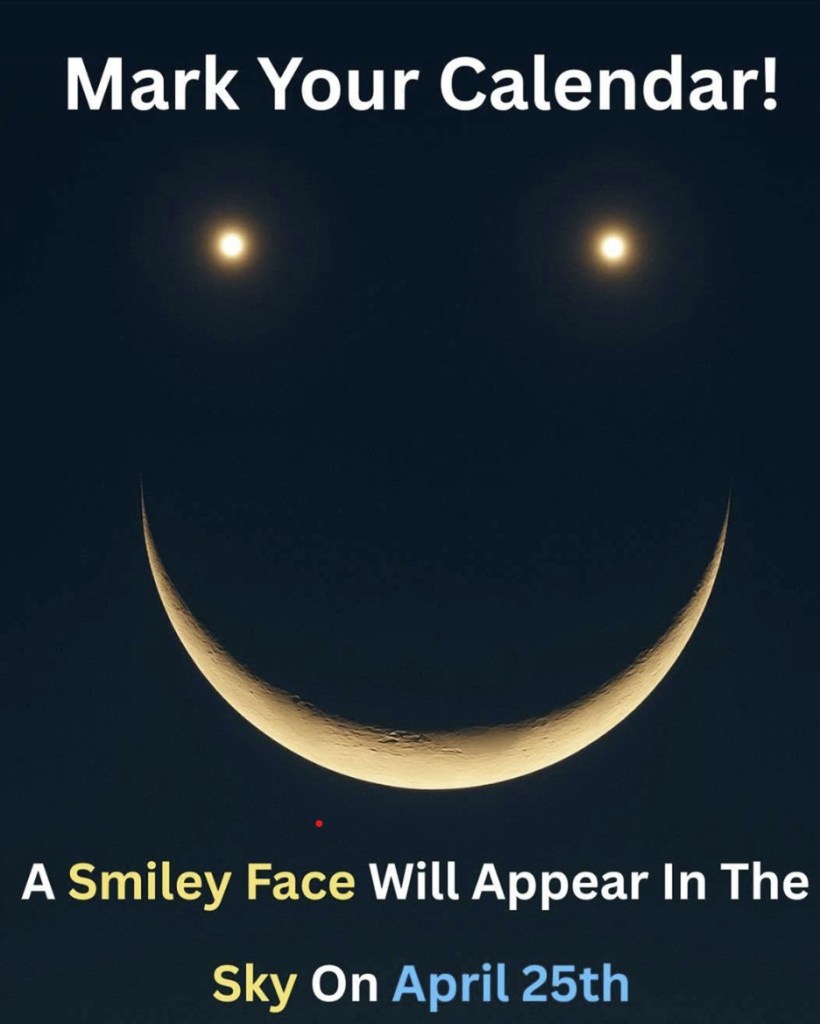
If you have followed my article to this point, you are certainly aware that this will not happen, but it is good example to show why astronomy is an excellent topic for a media hype and how to build it around an astronomical non-event.
How to build a media hype
Astronomy is a prime topic for media hypes, because many people are fascinated by the night sky, while at the same time, not having much of a clue about it. Throw in some esoteric nonsense and you have a perfect story that captivates a large, easy to manipulate audience.
So here is a step-by-step guide for astronomy lovers to build such a media hype:
- Take a minor but real astronomical event or a new discovery and blow it up to huge proportions, far beyond reality or reasonable predictions.
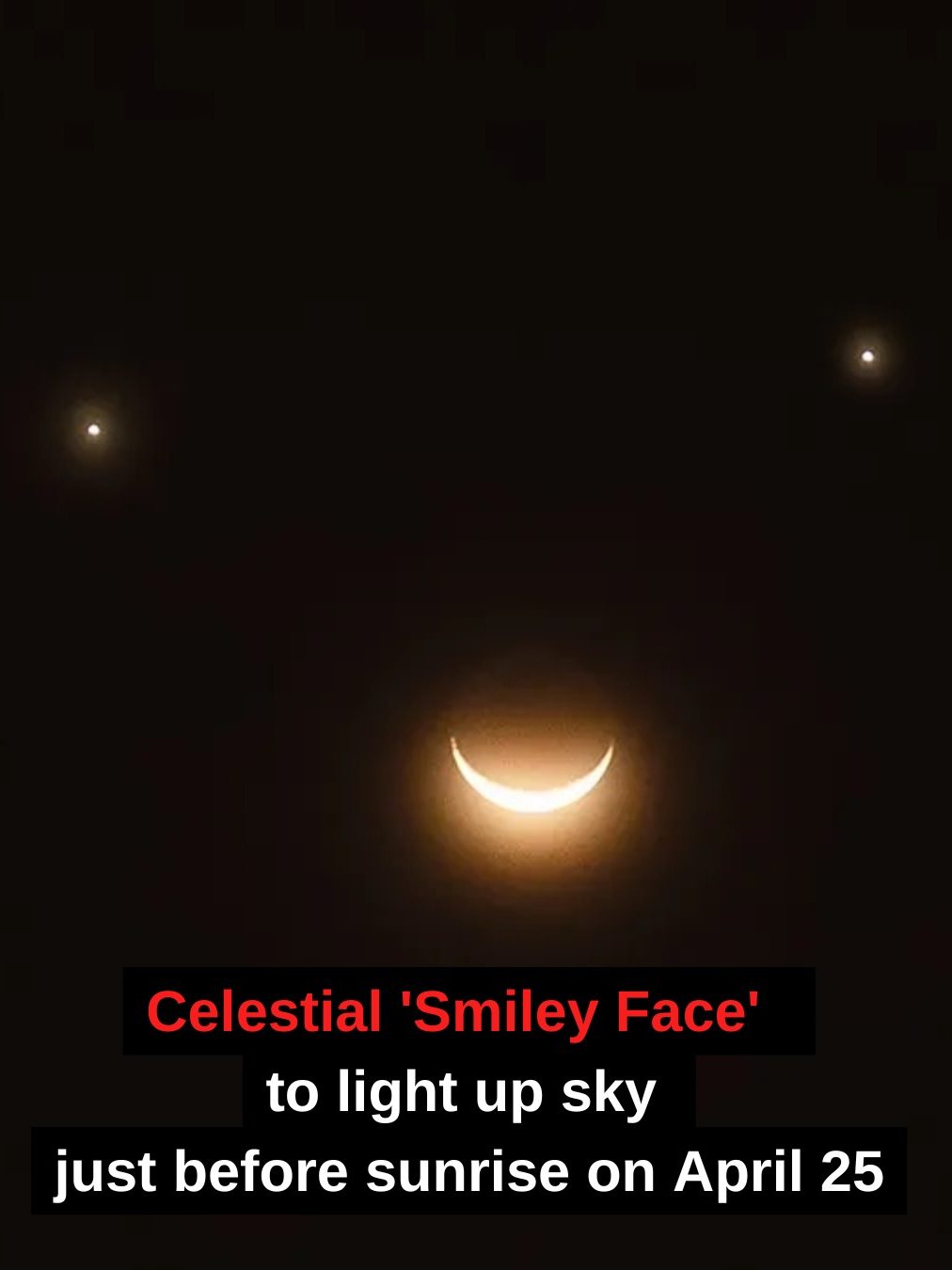
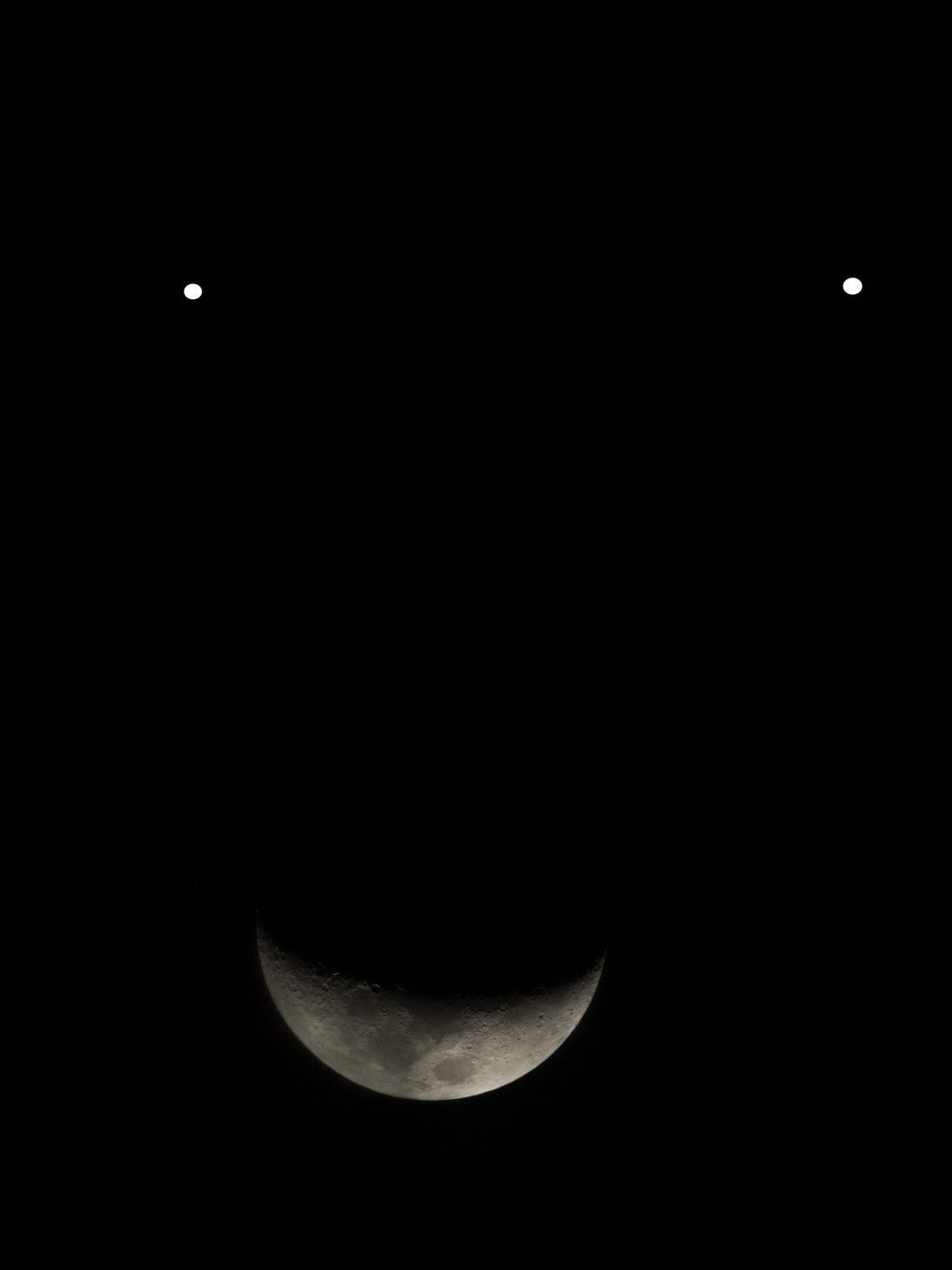
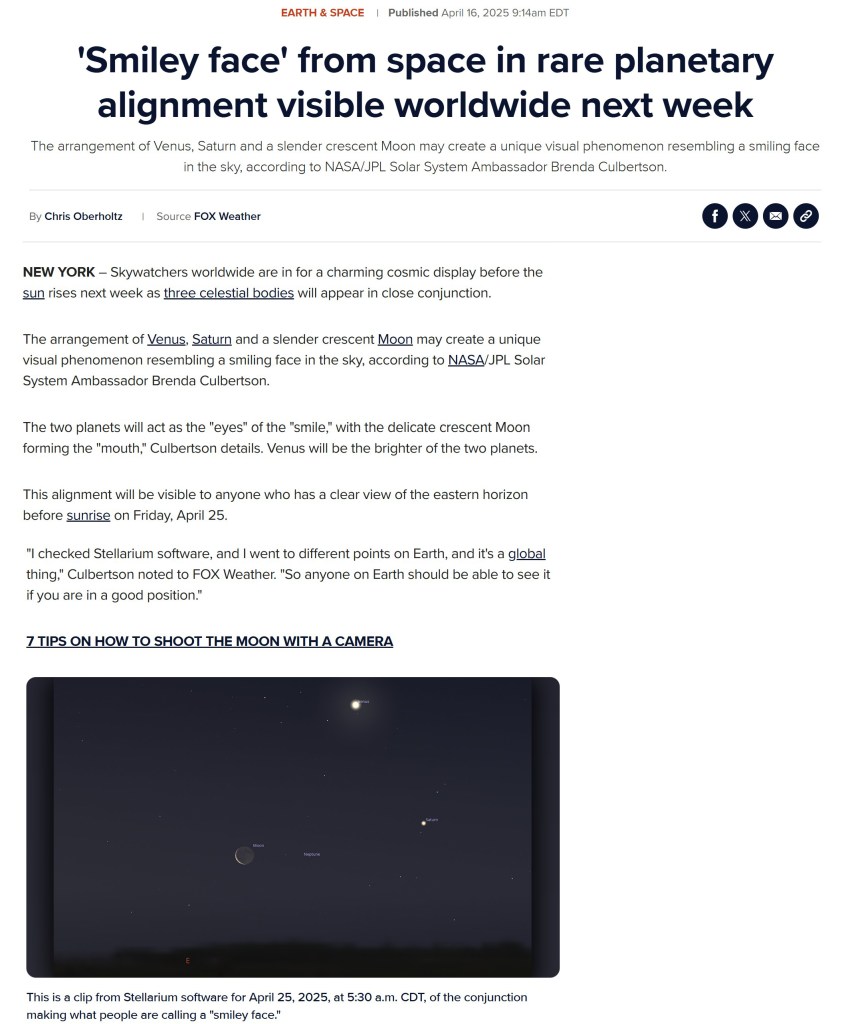
- Use computer or AI generated images to support your nonsensical claims. An image is worth more than a thousand words and will help to convince the uninformed. The image above is a good example for this and here are two more:
- Add an engaging text, emphasizing how rare the upcoming event is and that missing it would be a real shame. Then spread your story as widely as possible on social media.
- Other channels will soon help you selling your exaggerations to the unsuspecting public. While some comments will point out that this is utter nonsense, you can comfortably ignore them, as they will have no impact on the building avalanche.
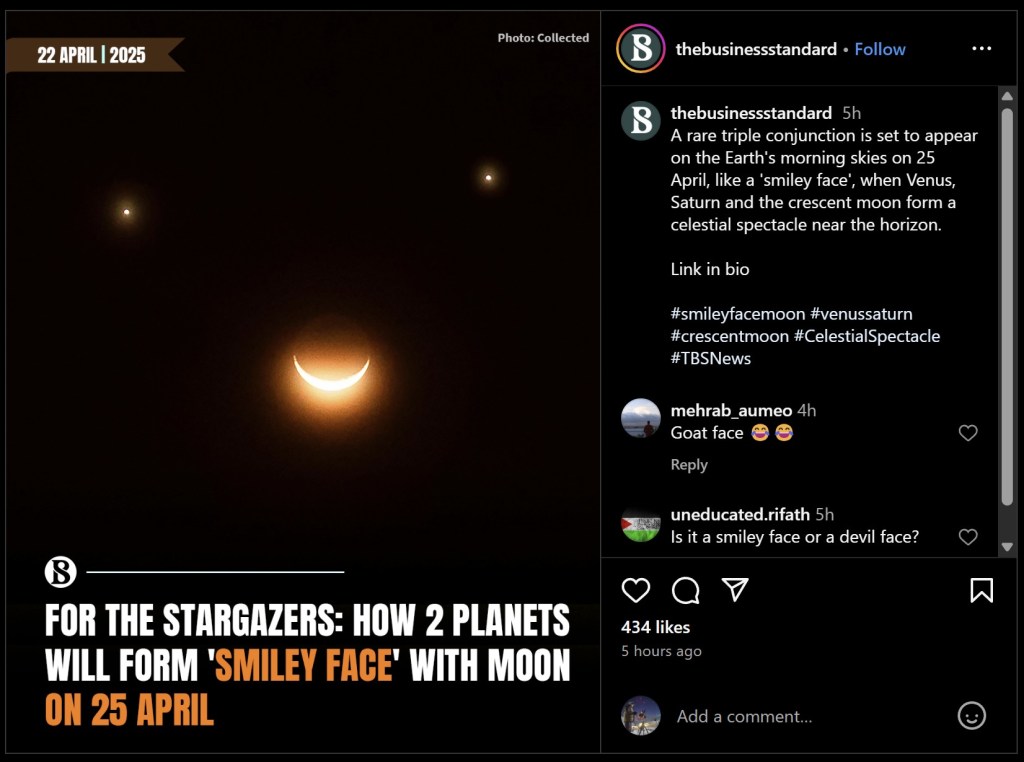
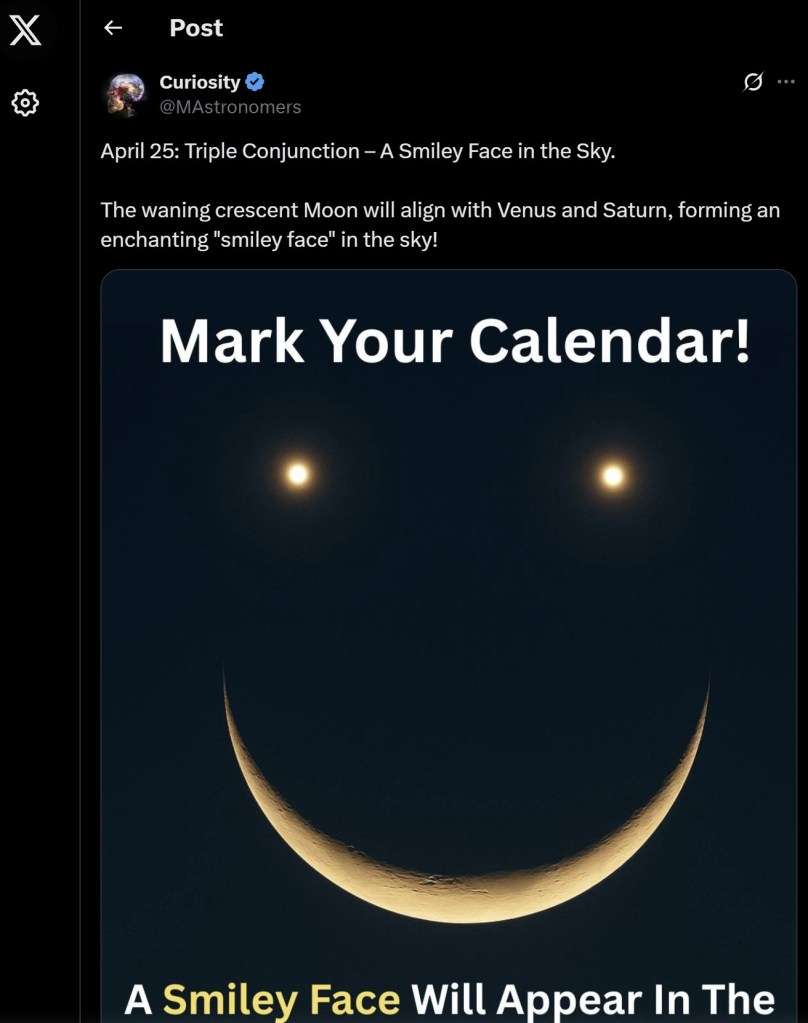
- Some ‘science’ platforms will also start to spread word. Most of these sites are far less scientific than their name implies and they will share anything sounding vaguely scientific without fact checking, as long as the story generates clicks.
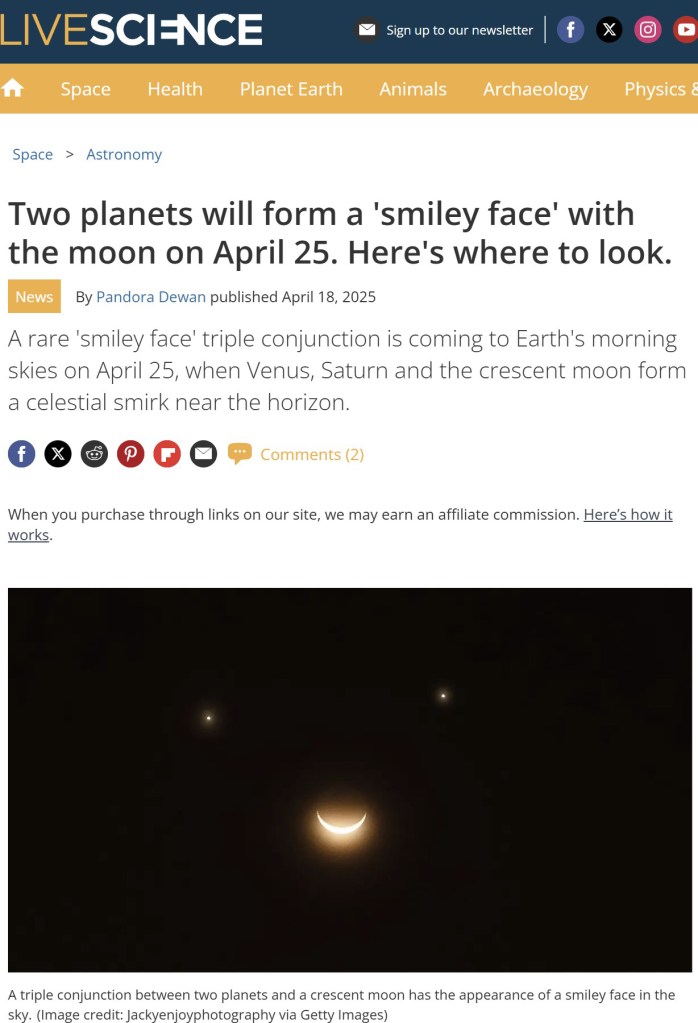
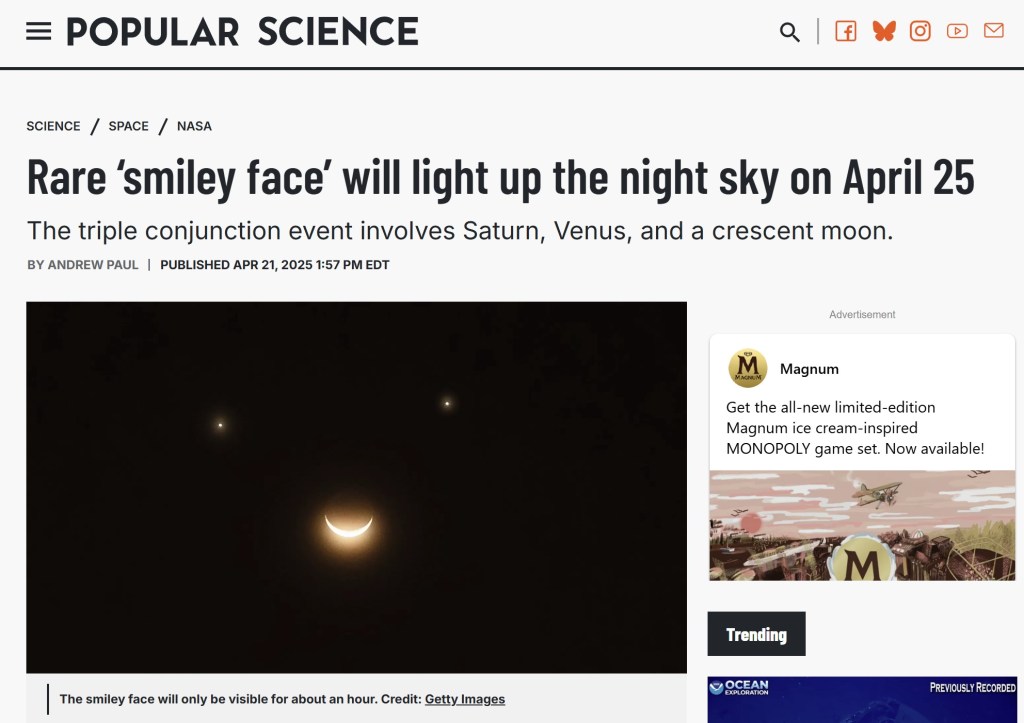
- General press outlets will now also start to share the story and quote the dubious ‘science’ platforms to bolster credibility. Some will even add their own flavor of silly graphics. After all, you have to stand out in the building flash-flood, right?
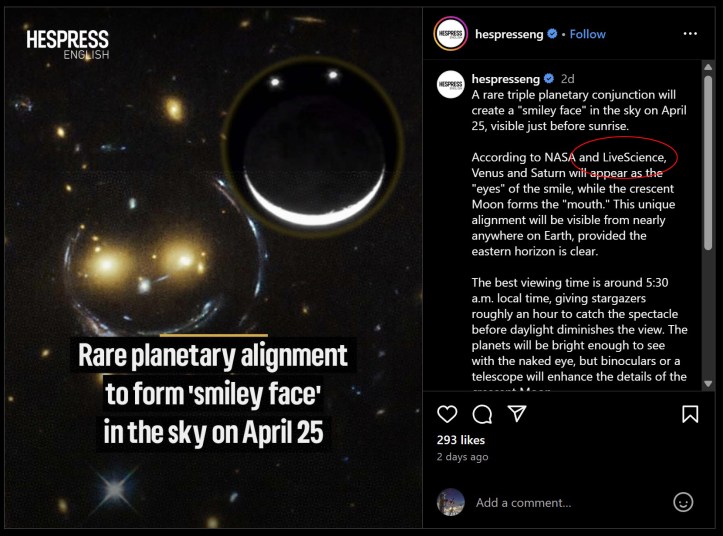
- Now, the traditional news networks can not ignore the trend anymore and will jump on board. As their journalists have as little astronomical knowledge as the rest of the world and checking facts is out of fashion anyway, the nonsense will pass most editors.
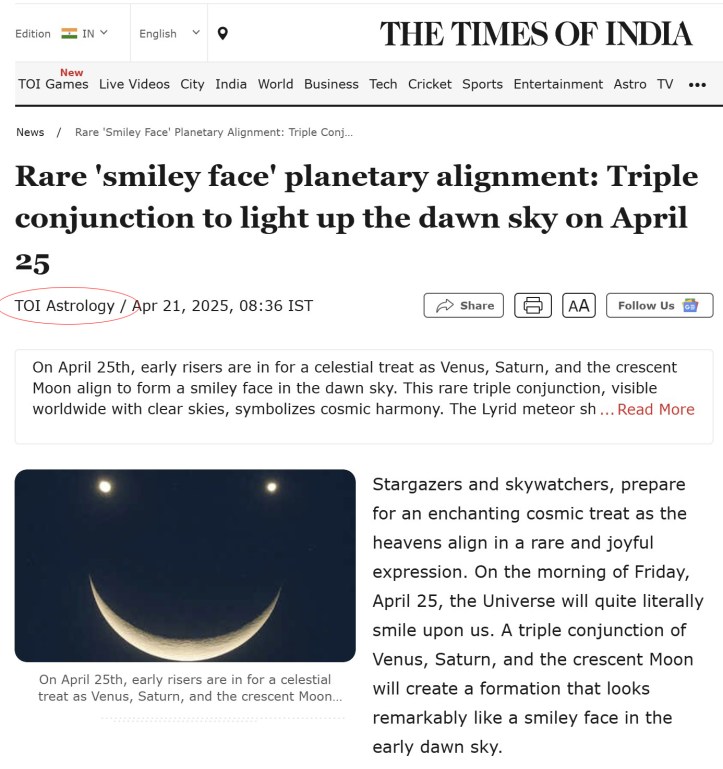
- Some news networks will of course notice the mistakes or have doubts and check back with experts, but the media hype has developed too far by now to be ignored. Thus, the better informed networks will choose the middle path and publish the story with a slight twist and own graphics, which can be a tad closer to reality, but they won’t disclose the hoax.
- Fox Weather is a good example: They asked a NASA/JPL Solar System Ambassador Brenda Culbertson, who seems to have been unaware of the building hype with completely exaggerated expectations, fueled by wrong descriptions and graphics. Whatever the FOX question was, the NASA astronomer seems to have quickly checked the popular planetarium software Stellarium and confirmed that the conjunction was real. That’s why a real event must be taken as base of the hype. Something totally invented would be disclosed quickly, but a huge exaggeration will go unnoticed by the busy experts in their ivory tower. Fox then used the Stellarium App to produce a graphic which is somewhat closer to reality, but they did not dig any further and did nothing to dampen the exaggerated expectations. They just gave the story a slightly different twist, still helping to fuel the hype.
- Now we have a full-fledged media hype that can not be stopped anymore. Of course, it will quickly ebb off after the supposed event and, unfortunately, it will leave behind many disappointed observers who either think they have missed a once-in-a-lifetime event or will turn their back on astronomy forever, because the event wasn’t nearly as impressive as they were told to expect.
How will it look in reality?
So, how will the conjunction really look in the whee hours of 25. April 2025?
This depends on where you observe from. In different parts of the world, the Moon will stand in different positions at 5:30 local time. Furthermore, the latitude also plays a role. The closer to the Equator, the darker the horizon will be when the conjunction rises and the higher in the sky it will be, before it is overwhelmed by the Sun’s glare. You can use the Stellarium Web-application to check how the alignment will look from your place.
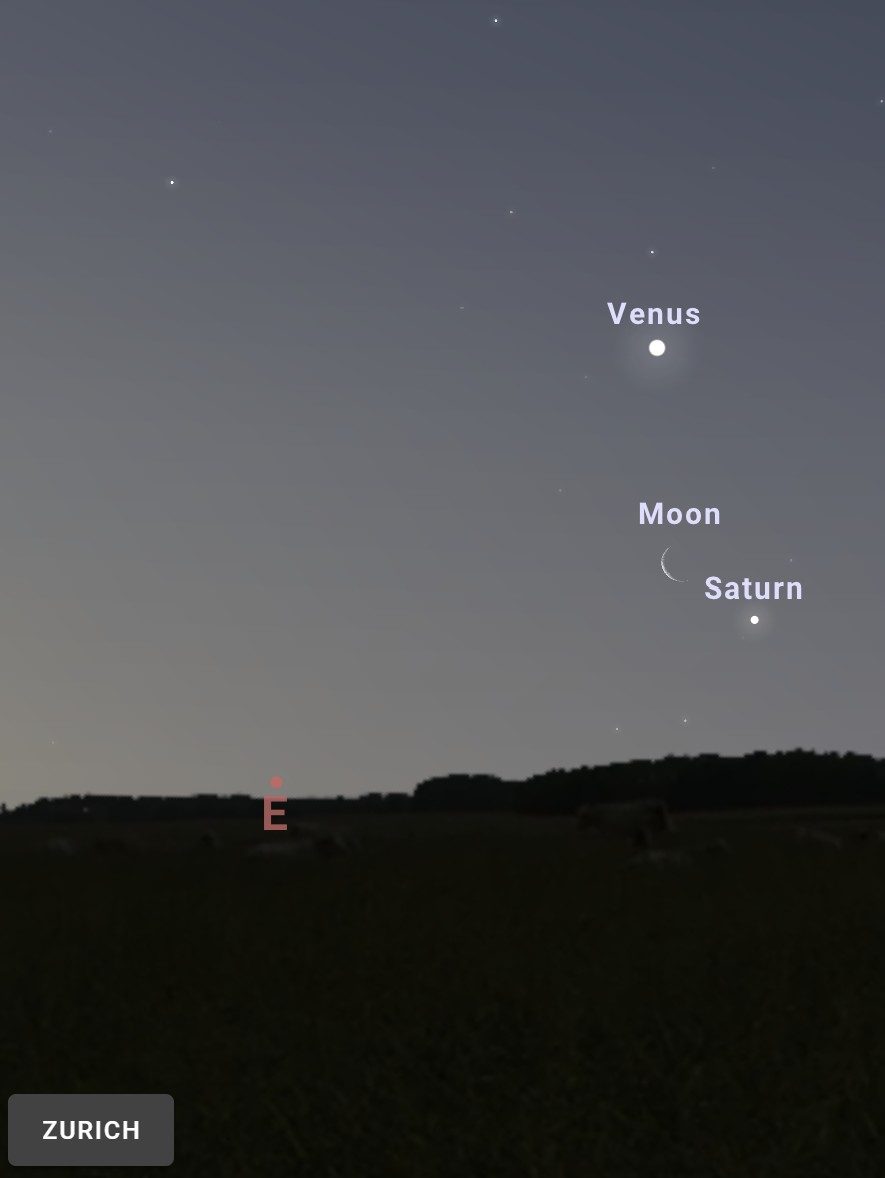
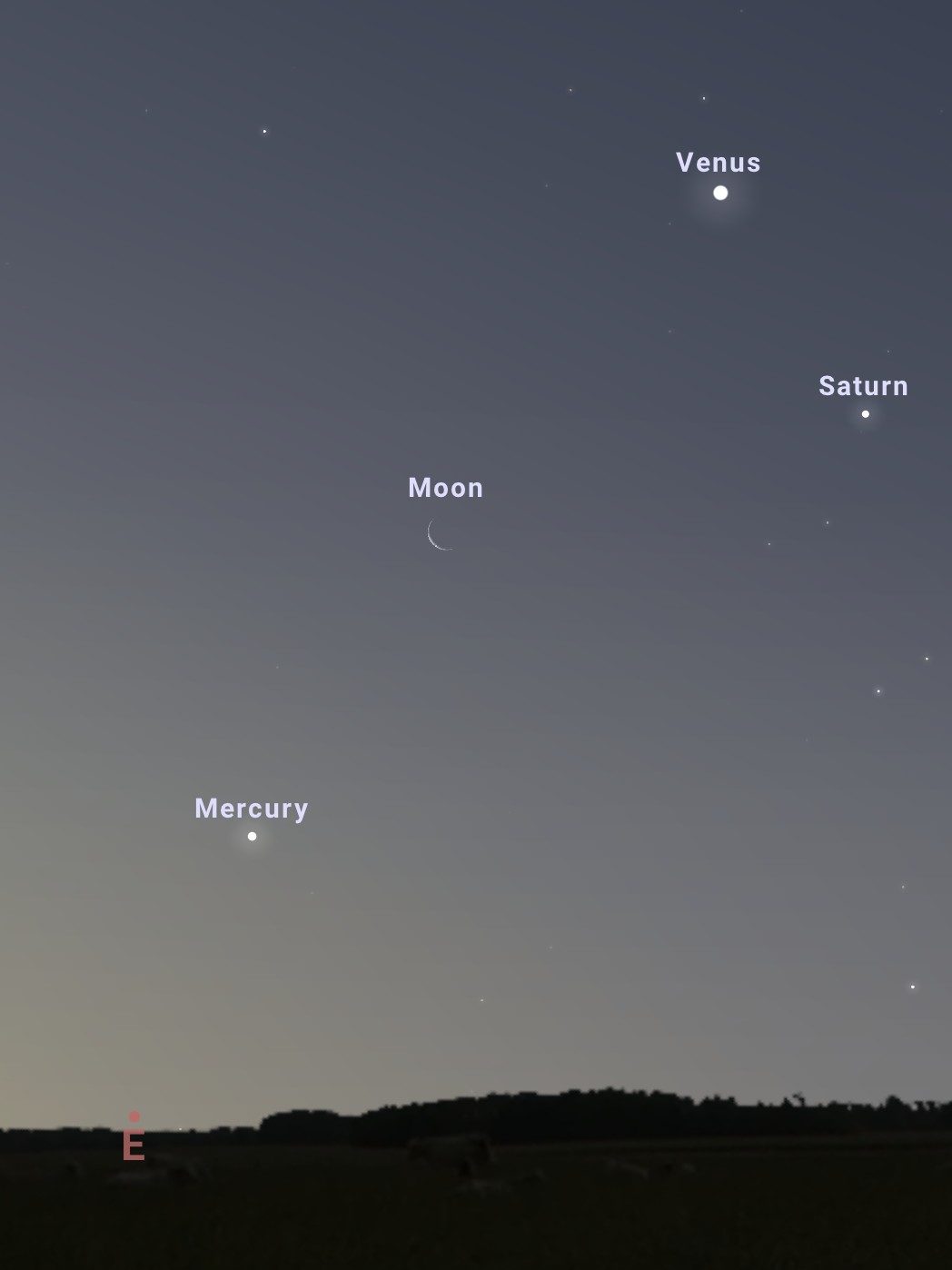
Here are 3 alignments covering India, Europe and the US. They show that, as stated by the NASA astronomer, the conjunction is global indeed. The smiley, however, isn’t – if there is a smiley at all:
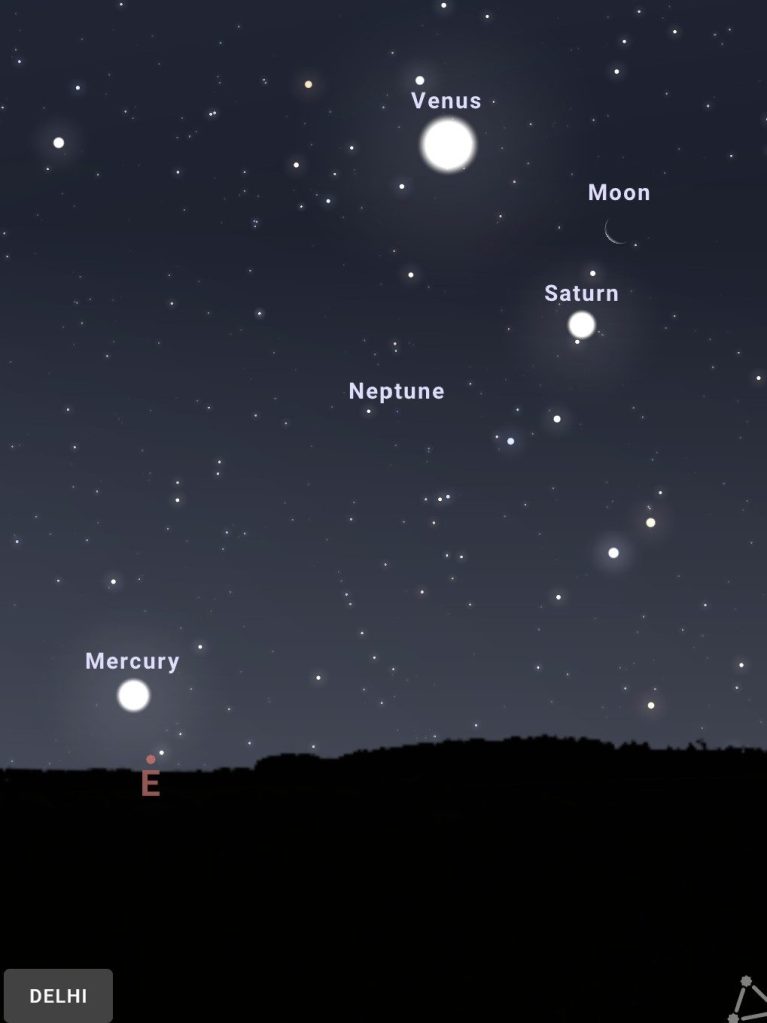
- The alignment in New Delhi, India, looks nothing like the one depicted in the Times of India article. The Moon is on the ‘wrong’ side of the planets. If anything, the smiley will be a very unhappy one – probably because it is standing upside-down.
- In my hometown Zurich, Switzerland, the Moon is much closer to Saturn than Venus and the conjunction will not look like a smiley at all. It will also be very low on the already bright horizon.
- In Los Angels, on the US West Coast, the Moon will be at a similar distance from Venus and Saturn, but the conjunction will be much wider. The smiley will have a rather small mouth. This is similar to what Fox Weather published, although the Fox graphic suppresses the brightening horizon.
The alignment is only part of the truth, though. The smiley, if you still can see one, will have two very different eyes. Some articles correctly point out that Venus will be brighter than Saturn, but I haven’t seen any clearly stating how big the difference is: With Venus at a visual magnitude of -4.4 and Saturn at +1.2, the difference is 5.6 magnitudes. This means that Venus will shine a whopping 400’000 times brighter than Saturn!
To make things even worse at mid-northern and northern latitudes, the conjunction will rise during morning twilight. This will make the dimmer planet Saturn hard to spot with the naked eye, while Venus will initially shine brightly through the increasing Sun’s glare. Thus, the smiley may very well be one-eyed!
Trying a simulation
Yesterday, I had the opportunity to capture Venus and Saturn from the flight deck during my flight to Singapore. Brilliant Venus was an obvious sight, but despite the clear and very low horizon on my cruising level, I had a hard time finding Saturn. Of course, the Moon wasn’t in position yet. To give you an impression how the conjunction will look from Zurich, I added the 10% illuminated waning Moon in Photoshop and adjusted the horizon for a latitude of Zurich.
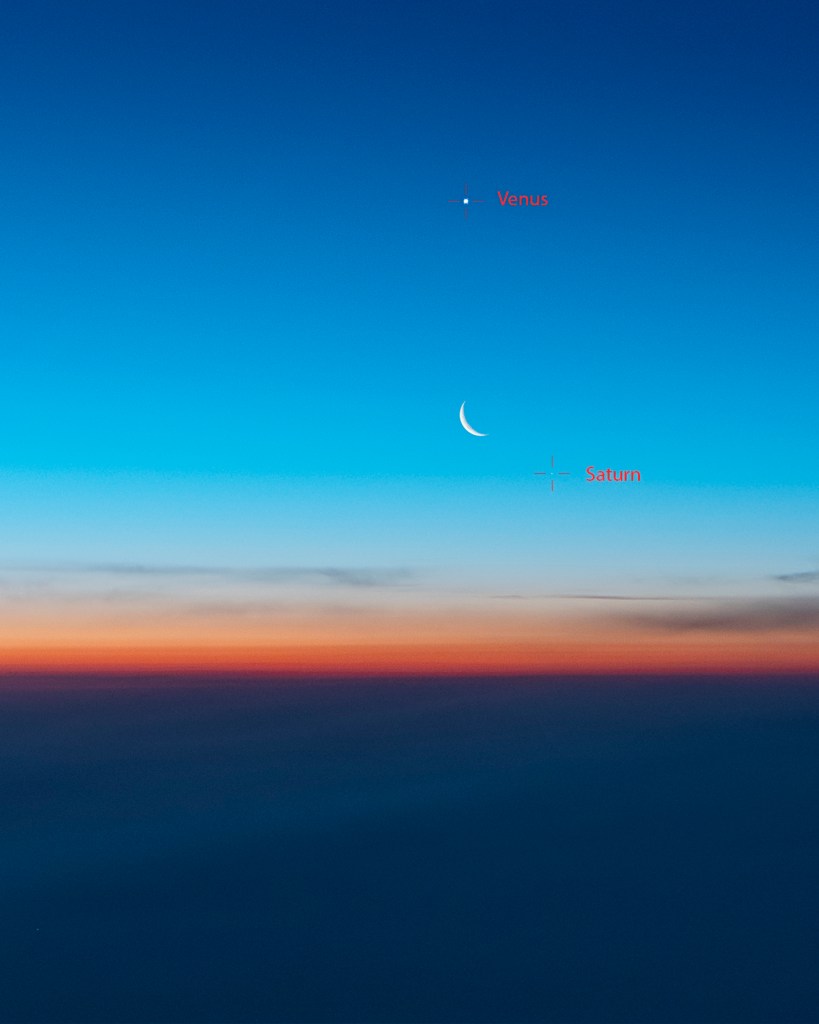
So is it still worth getting up to see the conjunction? Sure! It is always great to be out in nature and do some astronomy. With a longer focal length and an interesting foreground, you may even be able to capture a very nice image. However, do not expect to see anything like those silly images from social media.
 Skypointer Photography Blog